A faith-centered guide to building habits that strengthen your practice, protect your wellbeing, and keep your heart aligned with your purpose.
Medicine is among the most demanding professions on earth. Long shifts, life-and-death decisions, emotional weight that accumulates quietly over years — it takes something deeper than willpower to sustain. For Muslim doctors, that something deeper is faith. When you root your practice in Islamic values, your work becomes more than a career — it becomes an act of worship. Here are five habits that bridge the gap between your deen and your daily rounds.
Wake Up Early — Before the World Demands You
“And He it is who makes the night a covering for you, and sleep a repose, and makes the day as if a resurrection.” — Quran 25:47
There is something quietly powerful about the hours before sunrise. In Islamic tradition, these moments are considered mubarak — blessed. The Fajr prayer doesn’t just mark the start of the day; it frames it. When you begin your morning in the remembrance of Allah, you carry a different kind of steadiness into everything that follows.
For a doctor, this translates practically. The early hours offer uninterrupted time to review any new guidlines that is stuck in you mind, plan complex cases, or simply sit with a cup of tea and prepare mentally before the wards become relentless. Doctors who consistently wake early report better time management, greater emotional regulation under pressure, and less of the reactive anxiety that comes with feeling perpetually behind.
It isn’t about punishing yourself with a 4am alarm. It’s about reclaiming sovereignty over your day before the world’s demands crowd in. Start small — even rising thirty minutes earlier and sit in quiet reflection can shift the entire character of your day.
The doctor who begins the day with prayer carries more into the clinic than medical knowledge — they carry aura of Blessings.
Fight Laziness — Guard Your Goals With Intention
“O Allah, I seek refuge in You from anxiety and sorrow, weakness and laziness, miserliness and cowardice, the burden of debts, and from being overpowered by men.” — Sahih Bukhari
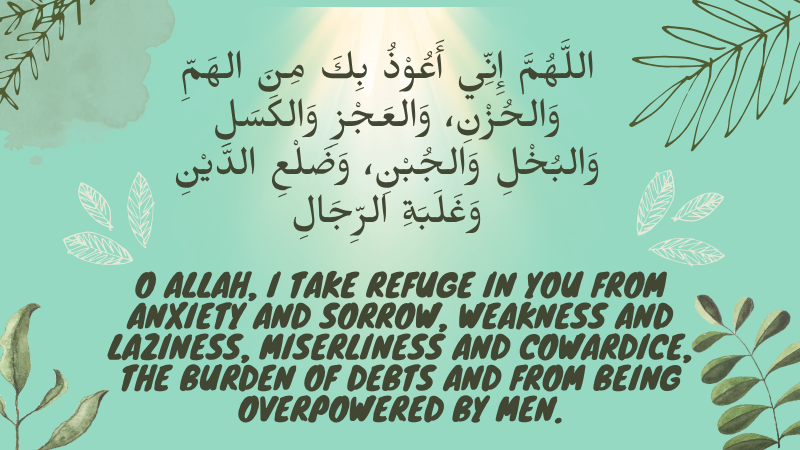
The Prophet ﷺ made this du’a regularly — and the inclusion of laziness alongside anxiety and cowardice is telling. Laziness isn’t just an inconvenience; it’s a spiritual risk. In a profession where inertia costs lives, the stakes of complacency are higher than almost anywhere else.
But fighting laziness isn’t about grinding until you burn out. It’s about clarity of purpose. When you know why you’re a doctor — not just what specialty you chose or which hospital you work at — you have an anchor. Write down your goals. Be specific: which skill do you want to master this year? Which habit do you want to build? Which type of patient do you most want to serve better?
Niyyah — intention — transforms ordinary work into ibadah. When a Muslim doctor walks into a clinic with the intention of serving Allah through the service of His creation, even the most routine consultation becomes something elevated. Revisit your intention often. Restate it. Let it be the engine that runs underneath everything you do, even on the hard days.
Never Stop Learning — Knowledge Is a Lifelong Obligation
“Seeking knowledge is an obligation upon every Muslim.” — Sunan Ibn Majah
In Islamic civilization, the pursuit of knowledge was never confined to religious sciences. Muslim scholars were physicians, astronomers, philosophers, and mathematicians — because they understood that understanding the world was a form of understanding its Creator. That legacy is yours to carry.
In modern medicine, knowledge has a shelf life. Guidelines change. New treatments emerge. Research published last year may already be outdated. A doctor who stops learning the day they receive their degree is, in some ways, already falling behind their patients’ needs. This isn’t meant to be a source of anxiety — it’s an invitation into one of the most dynamic, alive fields of human endeavor.
Attend conferences when you can. Subscribe to at least one journal in your specialty. Find a mentor whose practice you admire and observe how they think, not just what they prescribe. Most importantly, stay curious. Let your patients teach you — their questions often reveal the gaps in standard medical explanations that textbooks gloss over.
The Prophet ﷺ said: “Whoever travels a path in search of knowledge, Allah will make easy for them a path to paradise.” That path runs through medical libraries and conference halls just as much as it runs through madrasahs.
Practice Gratitude — And Stop Measuring Yourself Against Others
“And remember when your Lord proclaimed: if you are grateful, I will surely increase you in favor; but if you deny, indeed My punishment is severe.” — Quran 14:7
Medical culture has a quiet toxicity that doesn’t get talked about enough: the culture of comparison. Who published more. Who has a more prestigious fellowship. Whose salary is higher. Whose patients love them more. It’s exhausting, and it has nothing to do with being a good doctor or a good Muslim.
Gratitude is the antidote — not the passive, performative kind, but the kind that genuinely shifts your gaze. When you end a difficult clinic and think, I helped someone today who had nowhere else to turn, that is shukr. When you recognize that your training, your hands, your sound mind are gifts from Allah — and that millions of people on this earth would trade anything to have what you have — something softens.
This doesn’t mean accepting injustice or not advocating for fair pay and recognition. It means doing so from a place of sufficiency rather than scarcity. Grateful doctors are more present with their patients. They listen better. They notice more. They carry less of the restless dissatisfaction that turns good clinicians into burned-out ones.
Gratitude doesn’t make you complacent. It makes you grounded — and a grounded doctor is a safer doctor.
Protect Your Body and Mind — The Amanah You Often Forget
“The strong believer is better and more beloved to Allah than the weak believer, while there is good in both.” — Sahih Muslim
Your body is an amanah — a trust placed with you by Allah. You did not create it. You cannot replace it. And yet the culture of medicine often glorifies its destruction: the 36-hour shift worn as a badge of honor, the skipped meals, the chronic sleep deprivation, the habit of postponing your own appointments because you’re too busy caring for everyone else.
Physician burnout is not a personal failure. It is a systemic crisis — but one that Islamic values are particularly well-equipped to address. Salah, when performed on time, forces a pause five times a day. It is, functionally, a mindfulness practice built into the fabric of daily life. Sleep is explicitly called a mercy in the Quran. Eating well, exercising, and maintaining family ties are all emphasized as religious duties, not just lifestyle suggestions.
Make it non-negotiable: get enough slep. Eat food that nourishes, not just fuels. Move your body. Spend time with people who love you not because of your title but because of who you are.
A doctor who is depleted cannot give what their patients deserve. Self-care is not selfishness. It is the prerequisite for sustainable service — and it is entirely consistent with the teachings of a religion that told us “your body has a right over you.”
Your practice is an act of worship. Treat it that way.
These five habits are not a productivity checklist. They are an invitation to live with more integrity — to close the gap between who you are on Friday at Jumu’ah and who you are on Tuesday at 6am before your first ward round. When your faith and your work breathe together, something remarkable happens: the clinic becomes a place of meaning, not just medicine.
Start with one habit this week. Just one. Whichever feels most urgent or most neglected. Let it settle before adding another. Real change is never about doing everything at once — it is about returning, again and again, to what matters. And in Islam, we call that practice: istiqamah — steadfastness on the straight path.



0 Comments