Your house job year — or internship year as it is known internationally — is the most underestimated twelve months of your entire medical career. It is the one year where you are officially the most junior person in every room, which means everyone is still willing to teach you, guide you, and answer your questions without judgment. That window closes the moment you step out of internship. This guide is everything I wish someone had told me clearly at the start — the skills to prioritise, the habits to build, the mistakes to avoid, and the mindset that will make this year genuinely transformative rather than just being survived. Get official housejob notification here
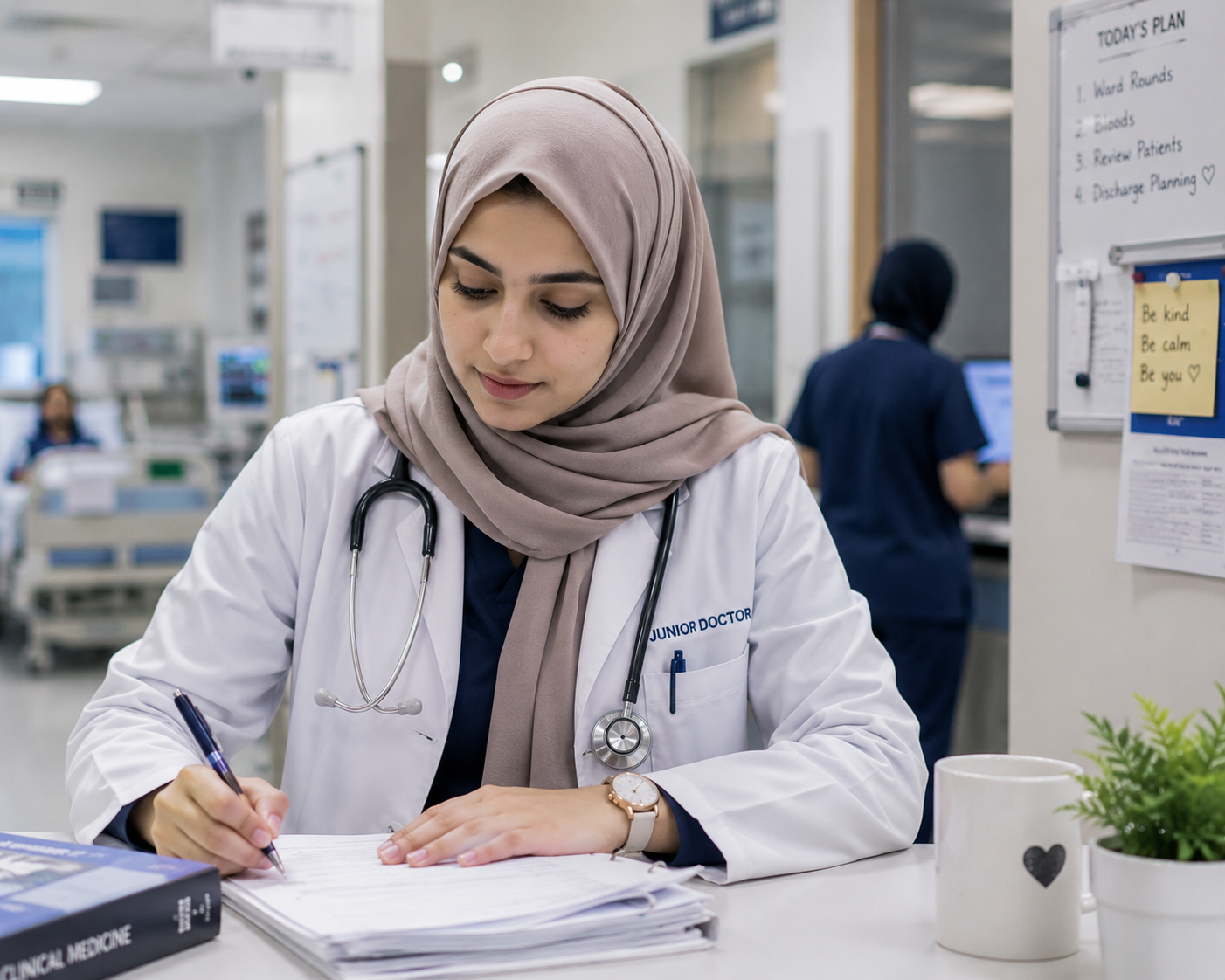
I remember my first week of house job vividly. I stood at the bedside of a patient and realised that everything I had studied for five years had given me knowledge — but very little of the ability to actually do. I could describe the steps of an NG tube insertion but my hands had never done it. I could list the differentials for acute abdomen but I had never fully assessed one alone. That gap between knowing and doing is what the house job year is designed to close. The question is whether you let it.
— Personal reflection on internship yearThe house job year is not an extension of medical school. It is the beginning of becoming a doctor. There is a difference — and how quickly you understand that difference determines everything about this year.
House Job Skills Checklist — Clinical Procedures Every Pakistani Intern Must Learn
There is a short list of minor procedures that you must learn to do with your own hands during your internship. Not observe. Not assist once and tick a box. Actually do — repeatedly, until your hands stop trembling and the technique becomes muscle memory. These are the procedures that will come up in every clinical setting you work in for the rest of your career and these skills will make room in your CV and helps you land a job after these 12 months.
Learn to place IVs yourself — even with a nurse present to supervise. It is tempting to step back and let the nurse do it because they are faster or you might faint on seeing Blood, BUT Come on MAN UP and do it. Nice and Slow. You will not always have an experienced nurse available, and the year to make mistakes under supervision is this one, they will help you if you did something you are not supposed to do, okay?
Complete House Job Guide — What to Focus on Each Month of Your Internship
Master Clinical Documentation — The Most Underrated House Job Skill
Documentation is the skill nobody teaches you formally and almost everyone does badly at first. Poor documentation is a medicolegal risk, a patient safety issue, and one of the first things senior doctors notice about a junior. Get it right from day one.
- Write every clinical note yourself under supervision — do not leave it for someone else to complete
- Never write your name alone on a clinical note — always include your PGR, SR, or on-call consultant’s name alongside yours
- Write notes that include: date, time, your name, designation, and the supervising doctor’s name
- Whatever you do, Document it. I again emphasize on documenting that beacuse only thing that will save you is your Documentation
- Document your clinical reasoning, patients condition, vitals, everything. There will be in no time patient deterioate and all burden is on you, Hence DOCUMENT EVERYTHING!
One of my juniors faced a serious complaint during her house job because a procedure she performed had complications and she had documentated nothing — no supervising PGR, no note of who was present, no record that the patient consented. The procedure itself was done correctly. The documentation made it look like it had been done unsupervised and without consent. The lesson cost her three months of stress and a formal review. Document everything, every time.
Learn to Properly Assess Patients — The Core Clinical Skill of Internship
The most valuable thing your house job will teach you — if you let it — is how to assess a patient properly. Not the textbook version. The real version. Walking in, looking at a patient, taking a history, examining them systematically, and forming a reasoned clinical picture. This skill is what makes a good doctor, and it cannot be learned from books alone. Think why this diagnosis is made and what is missed by you. Shadow your senior like your life depends on it.
- Never say “I can tell by looking at it.” Do the complete assessment every time — even when you feel certain
- Do a full functional assessment at least once on every patient you are responsible for
- Never assume “it’s functional” or “it looks like pancreatitis” without completing the workup
- Manage every complaint as if you are the only doctor available — this builds self-reliance
- When you get stuck, study the case first — then ask your senior why they ordered a specific investigation
The habit of asking “why did they order that investigation?” is one of the most powerful learning tools available to a house officer. Every investigation ordered by a senior is a teaching moment if you treat it as one. Most interns never ask. The ones who do are the ones who grow fastest.
Ask Questions Relentlessly — This Is Your Last Year to Be Spoon-Fed
You are the most junior person in every clinical setting during your house job. This is not a disadvantage — it is an enormous privilege. Seniors who would not explain their reasoning to a registrar will explain it to a house officer. Use this. Shamelessly. Completely. The window closes the moment you enter professional life.
- Spend time with the best doctor in your ward and watch how they talk to patients, make decisions, and handle complexity
- Ask questions — even questions that feel dumb. Especially those. No one will judge you at this stage
- Ask why — not just what. “Why did you choose this antibiotic?” teaches more than “what antibiotic do I prescribe?”
- When you encounter a case you do not understand, study it that evening and come back with more specific questions the next day
Professionalism During House Job — Respect, Reliability, and Presence
Your clinical skills matter,Your knowledge matters. But your professionalism — how you show up, how you treat people, how reliable you are, is what people will remember about you. Those Duas that will given to you by Patients and their Relatives has more effect on you life than you can thought of.
- Respect every person in the hospital — your colleagues, your seniors, your juniors, and the cleaning staff
- Do not be absent from your Duty Timings. An absent on-duty doctor when a critically ill patient arrives is a patient safety event and can lead to major chaos.
- Do not try to appear smarter than you are. Seniors can tell. It irritates them and closes doors
- Do not skip duties for trivial reasons. Your absences have consequences you do not always see
- Be the person your team can rely on. Reliability matters more than brilliance at this stage
- Your character during this year is being observed and remembered by people who will write your references
What Actually Matters After House Job — Practical Clinical Knowledge
There is something important you need to understand about what the real world values after internship. It is not the impressive procedures. It is not whether you can place a central line under pressure. What every patient, every GP, every future employer cares about is whether you can assess and manage common, everyday presentations competently and confidently. This is what your house job should build, above everything else. I will recomend that from first day of your job, just know about your future plans, your job after these 12 months and prepare for that in these days.
- Master common presentations: fever, sore throat, chest pain, shortness of breath, abdominal pain, headache
- Know your basic prescribing — safe doses, contraindications, interactions for the drugs you use daily
- Learn to communicate diagnoses clearly to patients in language they understand
- Build your ability to triage — recognising who is sick and who can wait is a skill that saves lives
- Read First Aid or any clinical guide casually and regularly throughout the year
The House Job Mindset — Do Not Waste Your Year Around People Who Waste Theirs
Every intern cohort has a mix of people. Some are curious, engaged, and working hard. Others are present in body but absent in effort — doing the minimum, avoiding procedures, just sitting idle or preparing for abroad exams. They not only increase the workload of their colleagues but they waste their skill learning time too. DON’T BE LIKE THEM!
- Do not adjust your standards to match the people around you who are not trying
- The patients whose cases you work hard on — their outcomes, their recoveries, their gratitude — are building you in ways that never leave
- The skills you build this year cannot be taken from you. They travel with you everywhere you go after this
- You are young, physically capable, and this intensity is manageable. Work through it
- Enjoy this year genuinely — it is intense but it is also the last time in your career when everyone is this actively invested in teaching you
Quick House Job Survival Checklist — Print This and Keep It
- Learn and perform all minor procedures hands-on — NG, Foley, IV, ascitic tap, gastric lavage
- Document every clinical entry with your name, supervisor’s name, date, and time
- Never leave documentation unsigned — get your PG or SR to sign before the file leaves you
- Complete a full patient assessment every time — no shortcuts, no assumptions
- Ask questions constantly — dumb questions included. This is the last year that is truly welcomed
- Study cases the same evening you encounter them — understanding deepens fastest when the case is fresh
- Spend time watching the best clinician in your ward and studying their decision-making
- Never disappear without handing over to a colleague — patient safety first, always
- Respect everyone — seniors, juniors, nursing staff, administrative staff, patients
- Do not match the effort of the people around you who are not trying. Do you
- Consider an online OPD course in your final rotation month
- Read First Aid or a clinical reference regularly throughout the year — small amounts, consistently
- If you plan to pursue IMC, PLAB, or USMLE — start the paperwork process during your house job, not after
- Build your portfolio: case logs, procedure records, department rotations clearly documented
- Enjoy it. Genuinely. It passes faster than you expect
House Job to International Registration — Start Planning Early for IMC, PLAB, and USMLE
If you are considering working abroad after your house job — whether through IMC registration for Ireland, PLAB for the UK, or USMLE for the USA — your internship year is the right time to be completely sure of things. Start Researching and ask seniors and be sure of your path after these days. When you step outside after your internship, You should have Clear Mindset of what you gonna do and in which fields!
Read Next
IMC Registration guide
If you are planning to register abroad after house job, give oet in hj and start its process.
Read Full Post →Nobody will teach you these things again. Not in the way they teach them during your house job — patiently, repeatedly, at the bedside, with time to ask questions and make mistakes and try again. The patients whose lives you touch during this year, the skills you build, the clinical instincts you develop — these are yours forever. They travel with you to every country, every hospital, every career milestone.
Work hard. Ask everything. Attempt everything. Respect everyone. And enjoy it — because the intensity of this year, the tiredness, the learning curve, the satisfaction of a patient who got better partly because of you — there is nothing quite like it, and it only happens once.



0 Comments