Let me say something people don’t say enough: OET is overhyped. The failure rates, the Facebook horror stories, the seniors who spent 3 months preparing and still retook it — none of that has to be your story. I know, because I sat the OET Medicine exam fourteen days after my housejob ended and passed.
This isn’t a motivational post. Well, maybe a little. But mostly it’s a practical, honest breakdown of exactly what I did — what worked, what didn’t, and what I’d do differently if I had to go back.
How It Actually Happened
My housejob officially ended on May 31st. I had already booked my OET slot for June 14th. The first two days? I didn’t open a single book. There were family gatherings, and honestly I was exhausted in that bone-deep way only housejob doctors understand. June 1st and 2nd were a write-off, and I’m at peace with that.
June 3rd arrived with a familiar feeling from final year,that productive panic that actually gets things done. I sat down, made a list of every section, and forced myself to be honest about where I stood. Listening: confident. Reading: manageable. Writing: needed structure but workable. Speaking: I told myself it’d be like our behavioral sciences roleplays, and I kept pushing it to the bottom of the list.
Speaking of OET
I underestimated Speaking. I told myself it was basically behavioral science roleplays — which is true, but that’s exactly the trap. Knowing it’s similar doesn’t mean you’re ready for it.
In our OSCEs, we had structured cases and patient actors who played along. In OET Speaking, the interlocutor plays the most persistently unsatisfied patient you’ve ever encountered. They push back. They’re anxious. They ask the same thing again. They need to be persuaded, not just informed and persuasion is a skill that requires practice.
I used chatgpt and different videos on youtube and focused specifically on opening sentences and empathetic phrases. I sat in front of a mirror and built sentences for each scenario until they felt natural.
On exam day, Speaking didn’t go the way I’d imagined. I stumbled in places. I walked out convinced that I had failed it. But when My result came out: It was PassedBand B. And Because I have prepared with multiple sources I did not know that their will be 2 roleplays in speaking session. After the one session I stood up to leave the room and then interlocuter said that there is one roleplay left. Ufff
Reading of OET
I was genuinely confident about Reading, and mostly that was justified. But on my actual exam day, Reading Part A was the hardest section I encountered. Instead of the usual diagrams, charts, and flowcharts I’d been practising on, I got dense, wordy paragraphs. Parts B and C ended up saving my score.
The lesson: practice on every format. Atleast practice 2 tests daily. Get comfortable reading long, unbroken medical prose. Skim, scan, annotate.
During Prep, When I got a question wrong and couldn’t understand why, I pasted the question into ChatGPT and asked it to explain the reasoning step by step — not to give me the answer, but to walk through the logic. That kind of analysis sticks far better than simply moving on to the next question and hoping for the best.
Writing of OET
Here’s something I wish someone had said to me earlier: you don’t need to write 500 letters. You need to write 10/15 and analyse each one like it’s a viva question. Writing hundreds of letters without understanding what went wrong is just practising your mistakes at scale.
Read the OET Writing criteria before you write a single practice letter. Language is only one of five or six scoring domains. Communication purpose, audience awareness, clinical accuracy — these all count alot. Many candidates write beautiful English that still scores poorly because it doesn’t address the actual task.
A few things worth knowing: practise writing to a physiotherapist, occupational therapist, speech therapist, and nurse — not just a consultant. Also practise both referral and discharge letters, not just one type. And read the task twice before writing a single word. Check your case notes carefully.
For feedback, ChatGPT is fine for grammar and a rough check — but it tends to add unnecessary content and inflate letters beyond what OET expects. Whenever possible, get your letters reviewed by a senior who knows the OET criteria. That feedback is worth ten AI corrections.
Listening of OET
Listening was my strongest section, and my main strategy was simple: skim the questions before the audio starts, never let a missed word break your concentration, and be especially alert in Part C where the language is dense. If Parts A and B go well, you can afford to lose a question or two in Part C without it damaging your overall score. Even if you zoned out, you can write something using your medical knowledge. Only thing I worried about listening is not zoning out. Drink a cup of coffee, chew a gum so you would not zone out and don’t miss a word
Resources That Actually Helped
What I Used (Honestly)
Jashan Files — Essential for Reading and Listening preparation. If you keep choosing the wrong option and can’t figure out why, Ask chatgpt. practice 2/3 daily.
Dr Zerak Naseer — Specifically for Writing. He gave a framework that helps me structure my letter.
Official OET Website — Here official OET Free sample tests (paper-based and computer-based), plus the free self-paced OET Doctor course module. Do all of it. This is the most accurate reflection of the real exam.
Official OET YouTube, E2, Mission OET, Swoosh OET — Good for understanding structure and section-specific strategies. Use them for orientation.
ChatGPT — Useful for explaining wrong Reading answers and basic Writing grammar checks. Not reliable for writing feedback.
My Result
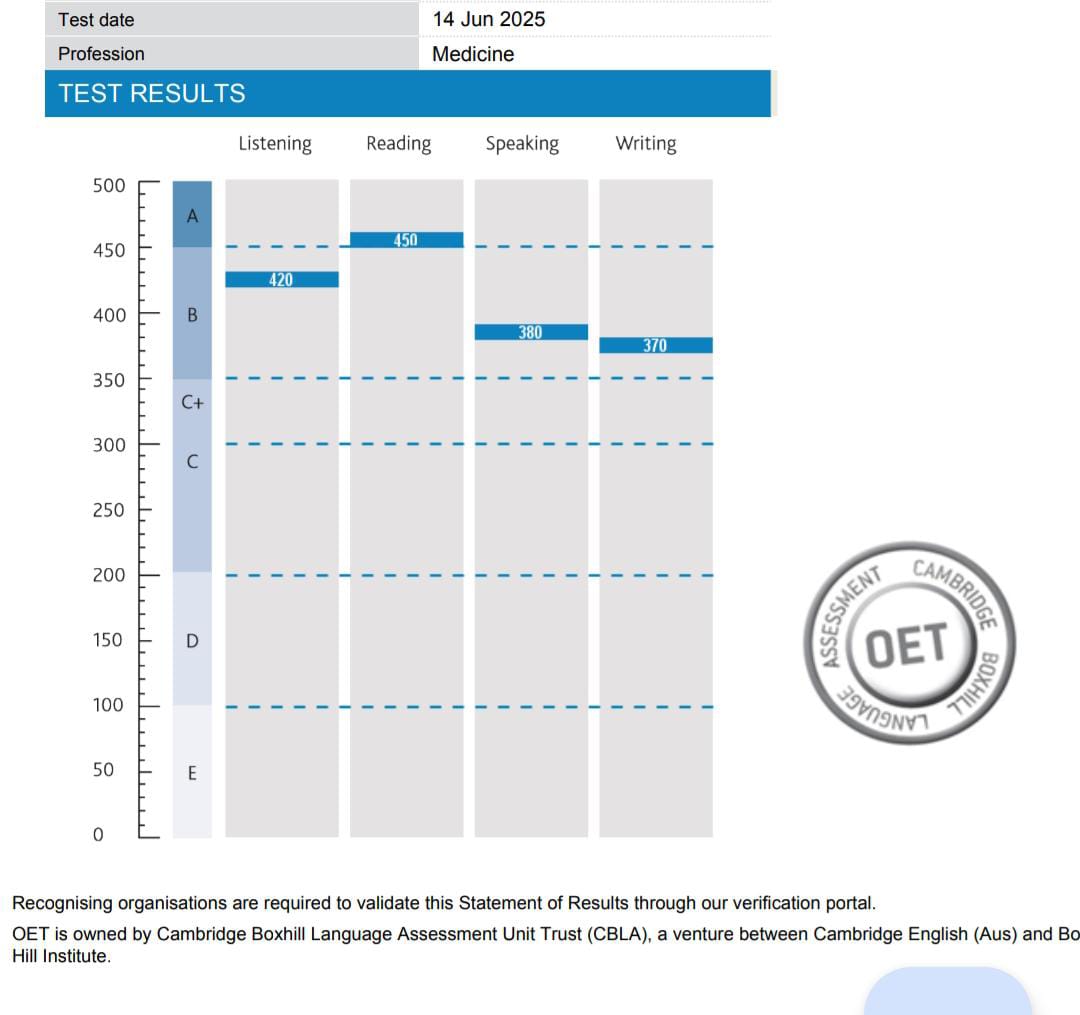
Final Bands — June 14th Sitting
14 days. No coaching centre. This is how it landed.
The Honest Takeaway
What OET doesn’t require is six months, an expensive coaching centre, or perfect English. It requires that you understand what’s being tested, that you practise deliberately by analysing mistakes rather than just clocking hours.
If I had one thing to go back and change: I’d have given Speaking three more days and treated it with the same seriousness I gave Writing from the start. Everything else I’d do exactly the same.
You can do this. Fourteen days is enough. Use them well — and feel free to drop your questions in the comments below. I’ll answer everything I can.




0 Comments