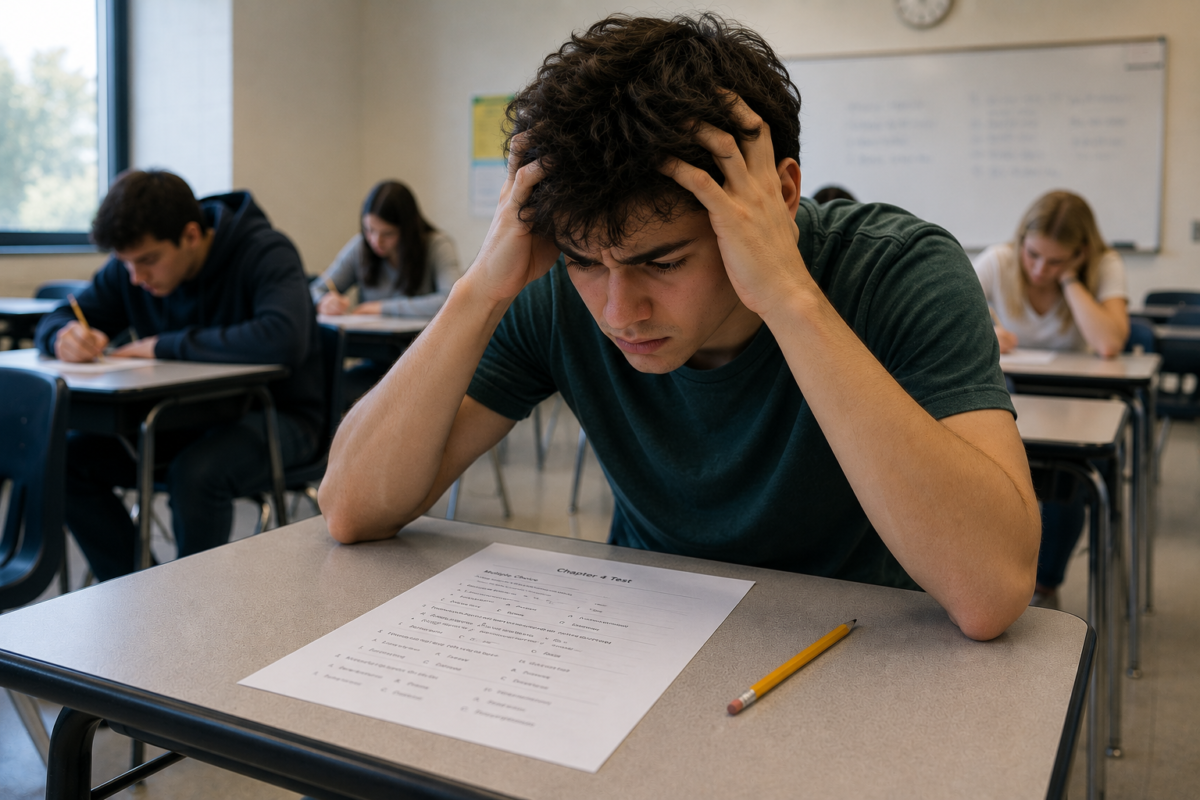
I have sat across from a lot of brilliant people who fell apart in exam rooms. Not because they did not know the material — they did. But because their body decided, right at the worst possible moment, that it was under attack. Heart pounding. Vision narrowing. Mind going completely blank. Test anxiety is real, it is physiological, and it can hijack even the most prepared student mid-exam. This post is about what to do when that happens — and it is written from both clinical experience and from having been in very high-stakes exams myself.
What Is Actually Happening in Test Anxiety
When exam anxiety escalates into a panic response, your body has activated its fight-or-flight system — the same cascade of adrenaline and cortisol that evolved to help humans run from predators. Your heart rate spikes. Blood is diverted away from your prefrontal cortex — the part of the brain responsible for memory retrieval, reasoning, and calm decision-making — and redirected toward your muscles. This is why you feel like you have forgotten everything. You have not. Your brain has simply locked you out of the room where all your knowledge is stored.
The good news is that this response can be interrupted. Deliberately and quickly. With the right technique, you can signal safety to your nervous system and bring blood flow back to your thinking brain within five to seven minutes. Here is how.
- Heart racing or pounding in your chest
- Hands trembling, sweating, or going cold
- Mind going completely blank on material you know well
- Difficulty breathing — shallow, fast breaths
- A strong urge to leave the room or give up
- Tunnel vision or feeling slightly detached from what is happening around you
If three or more of those sound familiar in an exam setting, this method is for you.
The Mindset That Changes Everything
Here is something I tell my students that always lands — think about soldiers preparing to go into battle. They are experiencing fear, their heart is pounding. They know, genuinely know, that things may go badly and they are sacrificing life. And yet they move forward. Not because the fear disappears. But because they have trained, they have prepared, and they have decided to trust that preparation over the voice in their head saying otherwise. They pick up their weapon and they walk forward anyway.They trust their weapon and their ability to use it according to the preparation and strategy.
Your pen — or your mouse, in a computerised exam — is your sword. Your months of preparation are your training. The exam room is not a place where you go to find out if you are good enough. It is a place where you go to demonstrate what you have already put in. Just trust yourself, You got it. Everything is in your hand, You can do it!
Step One — Create a Little Space
The first thing I tell my students is this: if you can step out of the room, do it. Not for long — just enough to remove yourself from the social pressure of being watched. The bathroom, a hallway corner, anywhere quiet.
If leaving is not an option — if it is a timed computerised exam or you cannot step out — that is completely fine. You can do everything that follows right in your chair, eyes closed, without anyone knowing what you are doing. I have had students do this in packed USMLE testing centres and walk back into their exam noticeably calmer.
Step Two — Breathe First. Everything Else Comes After.
Before any grounding exercise, you need to reset your nervous system through your breath. This is not soft advice — it is physiology. Slow, controlled exhalation activates the vagus nerve, which directly reduces heart rate and signals your brain to stand down from the threat response. Sixty seconds of this is enough to begin the shift.
Repeat for 60 seconds. Keep your eyes closed. Focus only on counting. Do this before the grounding exercise — and again after it.
The extended exhale is the critical part. A longer out-breath than in-breath is what activates the parasympathetic response. Do not rush it. Do not breathe from your chest — breathe from your belly. If your shoulders are rising, slow down.
Step Three — The 5-4-3-2-1 Grounding Method
After your breathing, open your eyes slowly and begin this grounding exercise. The purpose is to pull your attention out of your spiralling thoughts and anchor it firmly in the present moment — what you can perceive right now, with your senses, in this room. Work through each sense deliberately, naming things in your head clearly and fully.
👁️ Five things you can see
Look around slowly and name five distinct things in your environment. Be specific — not just “a door” but “the grey door with the silver handle in front of me.” Specificity is what grounds you. It forces your brain to engage with the here and now rather than the catastrophe it has invented.
I see the screen in front of me. I see my hands resting on my thighs. I see the grey carpet beneath my shoes. I see the overhead light. I see the water bottle on the desk beside me.🖐️ Four things you can feel
Not emotions — physical sensations. The contact between your body and its surroundings. This sense is particularly powerful for breaking a panic response because it is immediate and undeniable. You cannot argue with the feeling of your feet on the floor.
I feel my feet being supported by the floor. I feel the chair underneath me. I feel the fabric of my clothes on my arms. I feel the slight coolness of the air conditioning on my face.👂 Three things you can hear
Close your eyes for this one if it helps. Listen beyond the noise in your own head. You will be surprised what you notice when you actually pay attention. Even the quietest room has sound — distant typing, ventilation, someone shifting in their seat.
I hear someone typing nearby. I hear the hum of the air conditioning system. I hear the faint sound of footsteps somewhere down the corridor.👅 Two things you can taste
This one takes a moment — most people do not actively notice taste unless they are eating. That is exactly the point. It requires a slightly deeper level of attention and brings you further into your body and out of your head. If you chewed gum before the exam, this one is easy.
I can taste the faint mint of the gum I had earlier. I can taste the slight dryness of my mouth from the coffee this morning.👃 One thing you can smell
Smell has the most direct pathway to the brain’s limbic system — the emotional centre — of any of the senses. Even noticing a single scent can shift your state noticeably. Whatever it is, just notice it. There is no wrong answer here, and yes — even a difficult smell counts.
I can smell the faint scent of my own hand cream. I can smell the antiseptic in this hallway. I can smell literally nothing, and that is fine too.Once you have worked through all five senses, close your eyes and return to your breathing pattern — in for four, hold for two, release for four to five — for another sixty seconds. By this point, most people feel a measurable shift. The heart rate has begun to come down. The mind feels slightly less like it is unravelling. You are ready to go back in.
The entire process takes five to seven minutes. That feels like a lot when you are panicking. It is actually the best investment of exam time you will ever make.
One More Tip — When Self-Doubt Hits During Preparation
Test anxiety does not always start in the exam room. For many students, it begins the night before — or the week before — when they open a book and suddenly feel like they know nothing. Everything they studied feels like it has vanished. This is one of the most demoralising experiences in academic life, and it is almost never accurate.
When this happens, do not keep reading. Close the book. And quiz yourself — out loud, or on paper. Ask yourself questions. Keep going until you are getting them right. It may take ten minutes. It may take thirty. But the moment you start getting things right, you become confident. You are not just reassuring yourself — you are proving it to yourself. That feeling of competence is what walks into the exam room with you the next morning.
Test anxiety is not a sign of weakness, and it is not a sign that you are not ready. The techniques in this post are not tricks but are well-established, evidence-based methods for interrupting a physiological response that does not have to control your outcome. Use them. Practice them before your exam so they feel familiar when you need them. And walk into that room knowing that the work you have put in does not disappear when the nerves show up, it is still there, waiting for you to access it.




0 Comments